Year 5 Newsletter Spring Term
Spring Newsletter, Year 5
Happy New Year! We hope you have enjoyed your holidays and are looking forward to 2026. Thank you so much for my lovely Christmas presents. It was very thoughtful of you all.
Below you will find an outline of the curriculum areas that will be covered this term.
English
In English this term, we will be reading Rumaysa which is a Fairy Tale written by Radiya Hafiza. This novel puts a fresh twist on the classic fairytales: Rapunzel, Cinderella and Sleeping Beauty, retelling these fantastical, traditional tales within an authentic Islamic world. The unit will start with the children exploring and discussing fairytales. They will go on to create a number of varied written outcomes using the text as a starting point including narratives, dialogue, character descriptions, setting descriptions and diary entries before using the ideas and authorial devices identified within the text to plan, to draft, edit and publish their own fairytale prequel, telling the backstory of the witch.
We will then go on to study The Whale by Ethan and Vita Murrow. The Whale is a wordless picture book which captures the drama of an epic adventure story through haunting graphite illustrations in black and white. Relying solely on images to convey the magical tale, children will develop their skills of inference and deduction, and links will be made to other enchanting tales of hoaxes and mystical creatures. Children will be writing a range of text types such as a descriptive paragraph using textual clues, an emotionally charged piece in role as one of the main characters and a letter to the newspaper editor to suggest whether they believe the story or not. The sequence of learning culminates in children writing a film pitch for The Whale, focusing on vividly capturing the setting, atmosphere and emotions to secure funding to make the movie.
Maths
This term, we will be starting with a unit on Fractions which will include revising comparing and ordering fractions with related denominators, find unit and non-unit fractions of amounts and learn decimal equivalents for halves, quarters, fifths, tenths and hundredths. We will also be multiplying proper fractions and mixed numbers by whole numbers supported by materials and diagrams. We will then by focusing on Percentages and the children will learn to write percentages as a fraction with the denominator as 100 and as a decimal. They will go on to find 1% and 10% of amounts as well as solving problems where the whole is not known. Finally, we will focus on solving problems involving fractions and decimals to three places. Threse problems will require knowledge of percentage and decimal equivalents of 1/2, ¼, 1/5, 2/5, 4/5 and fractions with a denominator of a multiple of 10 or 25. We will regularly set the children problem solving investigations to develop their real-life problem solving and reasoning skills.
History and Geography
This term, we will begin by learning about early Islamic civilisation, studying Baghdad in around 900AD. We will learn about the development of teaching and learning based around the House of Wisdom and the importance of some of the ideas developed here for life today. Our geography topic will involve a study of rivers. We will revise the water cycle and then look at the many uses of rivers around the world including cleaning, cooking, growing crops, transport and creating power. We will study the three main stages of a river and then we will look into the causes and effects of flooding.
Science
We will be learning about forces, discussing what gravity and resistance are and identifying the effects of friction and water resistance. The children will have lots of opportunities to work scientifically, planning different types of scientific enquiries to answer questions. They will take measurements, use a range of scientific equipment, record results using scientific diagrams and labels, and report and present their findings using conclusions and scientific explanations. We will then be learning about Earth and Space. The children will describe the movement of the Earth, and other planets, relative to the Sun in the solar system and they will describe the movement of the Moon relative to the Earth. The children will use the idea of the Earth’s rotation to explain day and night and the apparent movement of the sun across the sky.
Computing
Our topic will be ‘Computational thinking’, which will include learning about the name and function of components making up the schools’ network and how information is passed between these components that make up the internet. We will learn what a source code for a webpage looks like and how it can be edited. We will also investigate how a website can be structured and how to add content.
Art and DT
Our Art this term will involve a study of paintings of water, including work by Maggi Hambling, Turner, Monet and Hockney and learning to apply acrylic paint in a style inspired by Hambling’s wave paintings. We will also be exploring ideas generated by Vernet’s painting, A Shipwreck on Stormy Seas, in Art Week.
In DT, we will be looking at framework structures and how to ensure strong joints.
RE and PSHE
In RE, we will be considering the impact of Christianity and Islam on music and art, linking our learning with our topic learning about Baghdad. In the run-up to Easter, we will also be exploring the significance of the resurrection story for Christians and looking at different ways this is presented in the Gospels.
Our PSHE this term will focus on healthy lifestyles as well as thinking about what it means to belong to a community. This will include how we can keep ourselves healthy, both physically and mentally, developing our learning about focus and concentration from the Paws b curriculum and building our ability to listen to and understand others as well as considering the importance of our actions for the environment and others in the world.
We will also be challenging gender stereotypes, understanding the use of gender in advertising. We will be learning how to develop healthy digital habits and considering ways to be safe and sensible with money.
Music
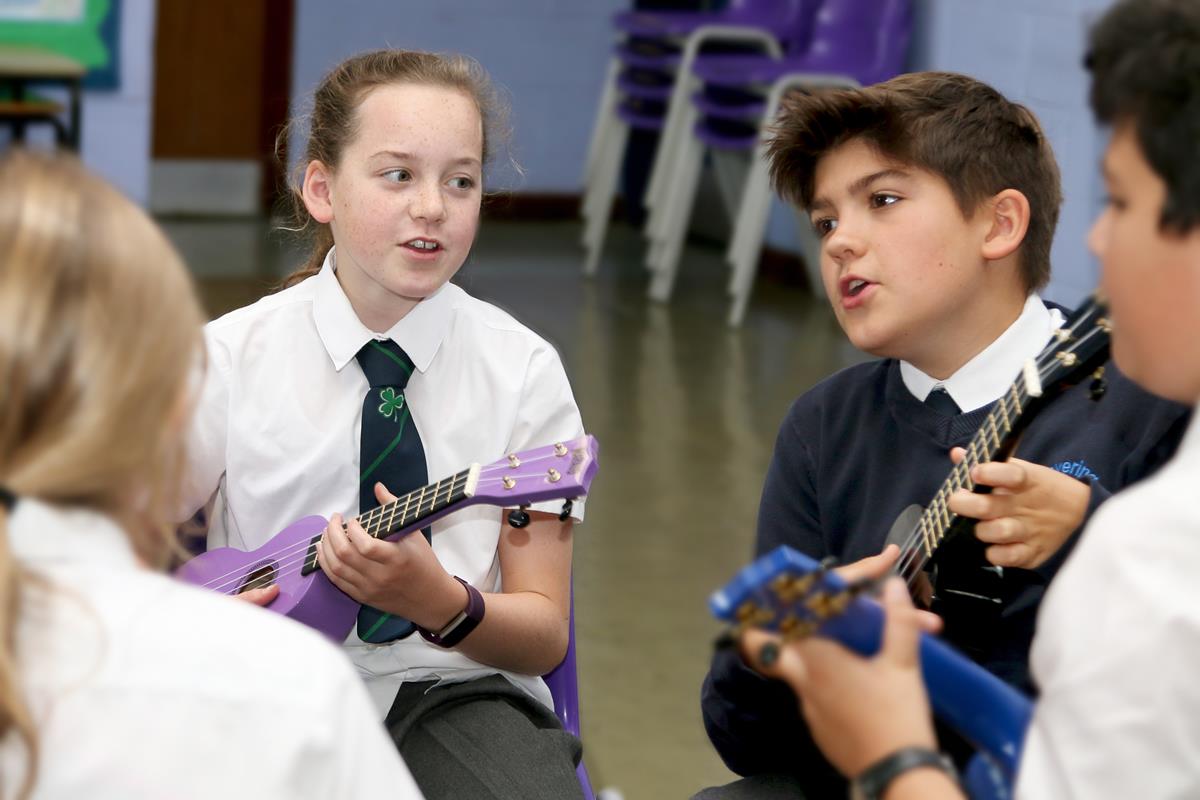
We will be following the Charanga music scheme focusing on Jazz. We will be studying the history of music and looking at Jazz in its historical context.
PE
During the first half term, PE will continue to be on a Wednesday afternoon and a Thursday morning. Mr Snelling will be teaching Hockey and Tag Rugby.
After half term, the children will be taking part in Netball and Dance.
French
We will be continuing to practice our spoken French and our numbers to 50 and will be broadening our vocabulary to order a range of food items in a shop and to tell the time to the quarter hour. We will also learn about our homes and how to name the rooms in a house in French. We are beginning to recognize the use of agreement in French and to apply this in our own sentence making and are becoming increasingly confident to spell and pronounce French words correctly. Our French ‘running dictations’ and in-class games help our ability to recall our learning but any further practice you feel able to do at home would also help this greatly.
Homework
The children will continue to be asked to complete 3 pieces of homework each week; these will include spellings (the children will bring home a copy of their new spellings lists at the start of each half term) and one piece each of maths and English/topic/science homework. Please ensure that your child presents their work neatly and to the best of their ability. If they have any questions, we are always happy to answer them.
For the Maths homework, we will be starting to introduce a weekly arithmetic paper on a Friday. Children need to attempt this independently and they have up to 30 minutes to complete it. I fully understand that around other commitments it is not always possible to put aside 30 minutes, if this is the case I would suggest you break the time into manageable chunks such as three lots of ten minutes. If your child has completed the paper before the 30 minutes is up, it is essential they go back through the paper and check all their answers and formation of digits. It is important children do not have any help (or access to a calculator!) so I can identify areas that need further securing. If your child is unsure of a question, encourage them to move on and return to the question if they have time at the end. Children must return the completed paper by the following Thursday ready to mark in class.
As ever, please encourage your child in their reading, giving them the opportunity where possible to sample a wide range of text types and support their interest in reading by discussing what they have read and by continuing to share texts together when possible. They should read daily at home, completing reading challenges regularly as they wish.
If you have any concerns or issues you would like to discuss regarding your child, please contact the office so that a meeting can be arranged at a mutually convenient time.
Thank you for your ongoing support.
Miss Ullmann